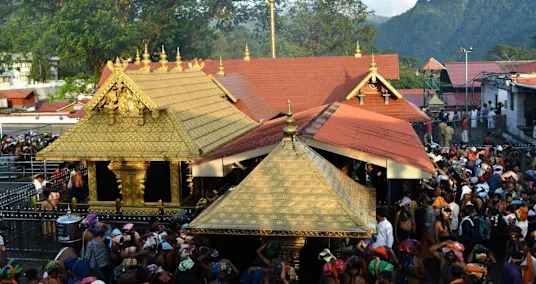
India's Supreme Court is hearing petitions challenging a landmark 2018 order that allowed women of menstruating age into the famed Sabarimala temple in southern Kerala state.
The nine-judge constitutional bench, set up by Chief Justice Surya Kant, will also consider other similar cases from different faiths.
So, the court's guidelines will also help decide whether women can be denied entry into Parsi temples and Muslim mosques, whether religious leaders can excommunicate people and the legality of female genital mutilation.
Legal experts say the court's decision will have far-reaching consequences for women's religious freedoms and right to enter places of worship.

The petitions challenge the landmark 2018 Supreme Court judgment which struck down the ban on women of menstruating age from entering Sabarimala.
Hinduism bars menstruating women from participating in religious rituals, regarding them as unclean. Many temples deny women entry during their periods and several devout women voluntarily stay away, but Sabarimala prohibits entry of all women between the ages of 10 and 50.
Dedicated to Hindu deity Lord Ayyappa, the temple attracts millions of male devotees from across the country every year. Many elderly women and young girls also visit the shrine.
In their 2018 order, the top court judges said keeping women out was discriminatory and unconstitutional as "the right to practise religion is available to both men and women".
Indu Malhotra, the only woman on the five-judge bench who has since retired, dissented with the majority verdict saying "issues of deep religious sentiments should not be ordinarily interfered [with] by the court... Notions of rationality cannot be invoked in matters of religion".
The verdict saw massive protests in the state and women who tried to enter the shrine were either sent back or, in some cases, even assaulted.
The top court received a number of petitions requesting it to review the judgment and strike down the 2018 order.
The court accepted the review petitions and in 2019 set up a seven-judge bench to hear the case. That bench decided to widen the ambit of the hearings and include in the review a number of similar cases from other faiths.
As some of the cases were issues of constitutional importance, a new nine-judge bench was set up in 2020 to hear the petitions – but it never made any progress because of the outbreak of the Covid pandemic.
Announcing the new bench at the weekend, Chief Justice Surya Kant said its hearing will determine "questions of law" in the case.
The bench includes Justice BV Nagarathna, the lone female judge in the top court who is due to become India's chief justice next year, and judges drawn from different faiths, castes and regions.
Reports say this careful selection of judges, representing different genders, religions, castes and regions, will help "lend wider legitimacy to a verdict that will inevitably traverse contested terrain".
Legal experts say the decisions taken by the constitutional bench would set the precedent for adjudicating similar cases.
In recent years, temples, mosques and shrines that have cited tradition to keep women out for centuries have faced an unprecedented challenge from women's groups who say denying them entry violates their fundamental rights.
Court cases have also been filed against denial of entry to Parsi women married to non-Parsis in the fire temple, and the practice of female genital mutilation in the small community of Dawoodi Bohras.
In the run-up to the hearings, the Travancore Devaswom Board, which manages Sabarimala, has urged the court to refrain from questioning faith-based practices. India's federal government has also told the court that they support the review petitions.
The hearings are set to conclude on 22 April.
LATEST POSTS
- 1
 8 Fundamental Stages: Novice's Manual for Secure Your Android with a VPN
 - 2Step by step instructions to Keep up with the Life span of Your Kona SUV's Battery Duration
- 315 Preposterous Cosplay Ensembles That Will Blow You Away
- 4NASA’s Artemis II mission will take an astronaut crew around the Moon – a space policy expert describes the long road to launch
- 5How a rare drug made from scientists' blood saves babies from botulism




- Drones, physics and rats: Studies show how the people of Rapa Nui made and moved the giant statues – and what caused the island’s deforestation
- Hyundai Is Keeping the i30 Alive While America Keeps Losing Cars Like It
- Bondi Beach survivor criticizes police for inaction during terror attack
- Pick Your #1 breakfast food
- Game theory explains why reasonable parents make vaccine choices that fuel outbreaks
- How to sound like an astronaut as you follow the first human moon mission in more than half a century
- The Manual for Electric Vehicles that will be hot dealers in 2023
- Remote Headphones: Improve Your Sound Insight
- Significant Elements to Consider Prior to Applying for a Mastercard: 6 Vital Contemplations