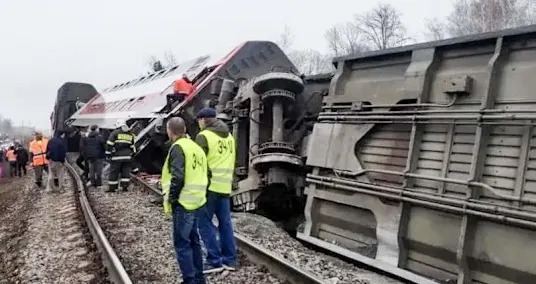
At least 55 people were injured in a serious train accident in Russia after the Moscow to Chelyabinsk night train derailed and seven double-decker carriages overturned.
No one was killed in the accident, according to state-run Russian news agency TASS, citing the authorities.
There were 415 passengers on board and at least 55 suffered minor or moderate injuries, regional governor Alexei Russkich said. Seventeen people are being treated in hospital, he said. Earlier reports put the number injured at 35.
Some of the passengers managed to climb out of the overturned carriages, as could be seen in a video on Telegram channel Baza.
The accident occurred near the village of Bryandino in the Ulyanovsk region, just under 800 kilometres east of Moscow, half way to Chelyabinsk in Western Siberia.
In seeking the cause of the incident, Russia’s State Investigative Committee pointed to the worn-out track bed, Interfax news agency reported.

LATEST POSTS
- 1
 Lilly, Novo lock horns in India's obesity drug race
 - 2France honors the victims of the Paris attacks' night of terror 10 years on
- 3FDA updates risk classification for voluntary shredded cheese recall
- 46 Novice Cameras for 2024: Ideal for New Picture takers
- 5A photographer's journey to capture a blood moon rising over the South China Sea. 'It was an incredible moment'



- Beyond oil: The crucial exports blocked by Hormuz closure
- US bishops officially ban gender-affirming care at Catholic hospitals
- Melodic Combination d: A Survey of \Unrecorded Music Energy\ Show
- 'The best gift ever': Baby is born after the rarest of pregnancies, defying all odds
- Excursion to Different Universes: the Top Sci-fi Motion pictures Ever
- From record warming to rusting rivers, 2025 Arctic Report Card shows a region transforming faster than expected
- Massive supernova explosion may have created a binary black hole
- Volkswagen in talks with defence firms on use of Germany plant: CEO
- Investigate Something else for Less: Financial plan Travel Objections