When you buy through links on our articles, Future and its syndication partners may earn a commission.

The sungrazing comet C/2026 A1 (MAPS) has been causing a stir in recent months as it brightened during its headlong rush towards the sun, which culminates in a high stakes close approach known to astronomers as perihelion on April 4. Here's how you can watch its final do-or-die approach for yourself through the technological eye of a sungazing spacecraft.
C/2026 A1 (MAPS) is thought to belong to the Kreutz family of comets — enigmatic solar system wanderers that are thought to have a shared progenitor and whose orbits take them perilously close to our parent star.
At perihelion, C/2026 A1 (MAPS) is expected to pass just 101,100 miles (162,700 km) from the sun's photosphere — a passage that could either spell its doom as volatiles buried beneath its surface vaporize and undermine its integrity, or may even see it shine bright enough to appear in the daytime sky.
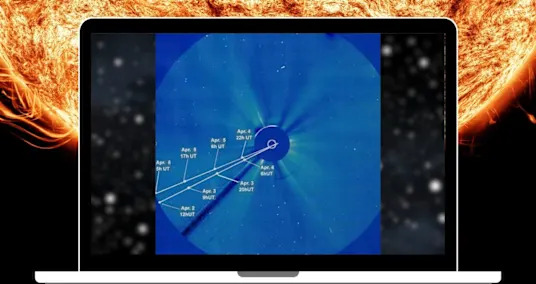
Either way, you may be able to spot the wandering solar system body as it careens towards the sun in imagery captured by the Large Angle Spectrometric Coronagraphy (LASCO) mounted on the joint ESA/NASA Solar and Heliospheric Observatory.

LASCO was designed to take detailed images of the sun's atmosphere by blocking out the light coming directly from its surface. Each of SOHO's "C3'" images captures a field of view 32 times the diameter of the sun, revealing how material ejected from its surface interacts with the space environment and, occasionally, detecting the presence of interlopers, such as C/2026 A1 (MAPS).
Space.com columnist Joe Rao forecast that comet C/2026 A1 (MAPS) will enter the LASCO instrument's field of view from 8:00 a.m. EDT (1200 GMT) on April 2 through to 1:00 a.m. EDT (0500 GMT) on April 6. It will briefly disappear as it passes into the blind spot created by the instrument's occulter disk for the four hours surrounding periohelion, before emerging back into LASCO's field of view, assuming it survives the close brush with our parent star.
LATEST POSTS
- 1
 Hundreds of Intact Dinosaur Eggs Emerge From 72-Million-Year Time Capsule
 - 2How Skoda Lost Its Biggest Market In Just Seven Years
- 3Bowen Yang is reportedly leaving 'Saturday Night Live' after this week's episode
- 4Israeli strikes in Gaza kill 25 people, Hamas health authority says
- 5Women take pride in Holy Week roles after a Spanish Catholic brotherhood's procession excluded them





- Which Exhibition hall Do You Suggest? Vote
- It Shouldn’t Be Here: Rescuers Race to Save Whale Stranded in Rare Spot
- Track down the Ideal Weight reduction Methodology for Your Way of life
- Tasting America: An Excursion Through Darling Cheap Food Brands
- Aluminum salts emerge as likely target as health officials scrutinize childhood vaccines
- Style Narratives: A Survey of \Patterns and Styles Assessed\ Design
- Ocean side Objections: Staggering Waterfront Breaks
- King Charles shares cancer treatment update, says it's a 'personal blessing'
- Shadow Cats: The Elusive Leopards Surviving Against Impossible Odds